
 Posts
Posts


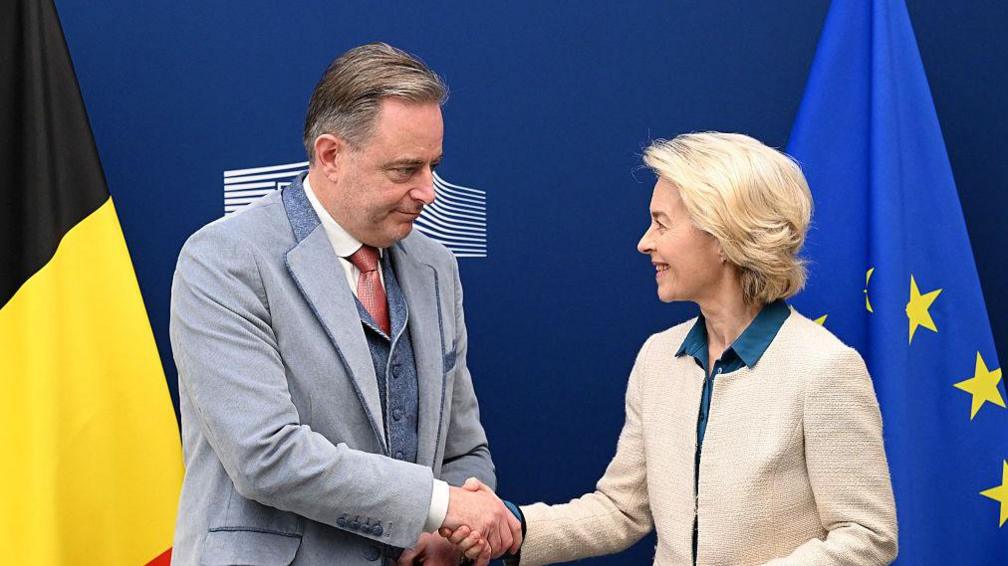
Why does Belgium oppose the EU's use of frozen Russian assets?
Faced with Ukraine's pressing military and financial needs, the idea of the European Union (EU) using frozen Russian assets has gained traction in recent weeks.
Key European leaders, such as the President of the European Commission, Ursula von der Leyen, and several heads of state and government, support this approach.
Belgium's opposition
Currently,
€165 billion ($192 billion) of Russian assets are frozen at the
Euroclear clearing house in Brussels, Le Monde reports. In a letter
addressed to Ursula von der Leyen on November 28, Belgian Prime Minister
Bart De Wever described the European plan to use these funds to support
Ukraine as "fundamentally flawed."
“We are ready to make sacrifices, but we cannot ask this country to do the impossible,” Bart De Wever told the Belgian Chamber of Deputies on Thursday, December 4, according to RTBF. He specifically mentioned compensation for an “illegal expropriation,” which, he said, could exceed the total value of the assets.
Recalling his government's loyalty to Europe and Ukraine, he stressed that "Belgium will never accept to assume the risks of such an operation alone" and argued for a collective European loan.
European pressure
Belgium's
reservations haven't deterred some capitals from moving forward on the
issue of frozen Russian assets. On Monday, December 8, seven EU member
states (Estonia, Latvia, Lithuania, Poland, Sweden, Finland, and
Ireland) sent a letter to European institutions to support a remediation
loan for Ukraine. The operation would be based on the Russian Central
Bank's assets held in the EU, particularly at Euroclear.
Quoted by Belgian public broadcasting, the signatories believe that this solution is "realistic" and "financially the most accessible", given "the current scale and urgency of Ukraine's budgetary and military needs".
Towards a compromise?
In recent days, this unusual conflict between Belgium and Europe has turned into a showdown between a determined Bart De Wever, eager to make his country's voice heard, and an Ursula von der Leyen who wants to accelerate the Ukrainian issue.
On Friday, December 5, she and German Chancellor Friedrich Merz dined with the Belgian Prime Minister to try to persuade him to soften his stance. Quoted by Euronews, Merz stated that he understood "the concerns of the Belgian government, given that the majority of the frozen assets are held in that country." He called for a political compromise that would establish legal mechanisms to protect Belgium.
European leaders are due to meet on December 18th in a European Council to decide on EU financial and military support for Ukraine. Will a compromise favorable to all parties be reached?


No comments:
Post a Comment
Note: Only a member of this blog may post a comment.