
 Posts
Posts


Japan Getting Nuclear Submarines?
The leading candidate to succeed Prime Minister Suga announced his support for building nuclear-powered subs, but acknowledged the challenges.
Kono Taro, who has a commanding lead in polls to head Japan’s ruling Liberal Democratic Party and succeed the outgoing Suga Yoshihide as prime minister, expressed support for building nuclear-powered (not nuclear-armed) submarines this week. While being questioned alongside other candidates in a televised forum, he called the development of nuclear submarines a “very important” capability for Japan.
Kono is a former foreign minister and defense minister, and currently oversees the distribution of COVID-19 vaccines in Japan.
 Alongside
his support for the idea, Kono also acknowledged that the politics and
economics of procuring a fleet of nuclear submarines was complex, so his
answer likely should not be interpreted as a pledge to pursue such a
program should he become prime minister. “Whether there are regions [in
Japan] willing to host them… or whether the operating capabilities or
costs are pragmatic, these are issues we need to consider going
forward,” he said.
Alongside
his support for the idea, Kono also acknowledged that the politics and
economics of procuring a fleet of nuclear submarines was complex, so his
answer likely should not be interpreted as a pledge to pursue such a
program should he become prime minister. “Whether there are regions [in
Japan] willing to host them… or whether the operating capabilities or
costs are pragmatic, these are issues we need to consider going
forward,” he said.
 Aside
from the expense and difficulty of building the actual submarines,
creating the required industrial and institutional infrastructure to
support a fleet of nuclear submarines, and developing the cohort of
people needed to operate, maintain, and repair them, is itself an
extraordinarily complex, expensive, and lengthy endeavor. Admiral Mike
Gilday, head of the U.S. Navy, recently praised
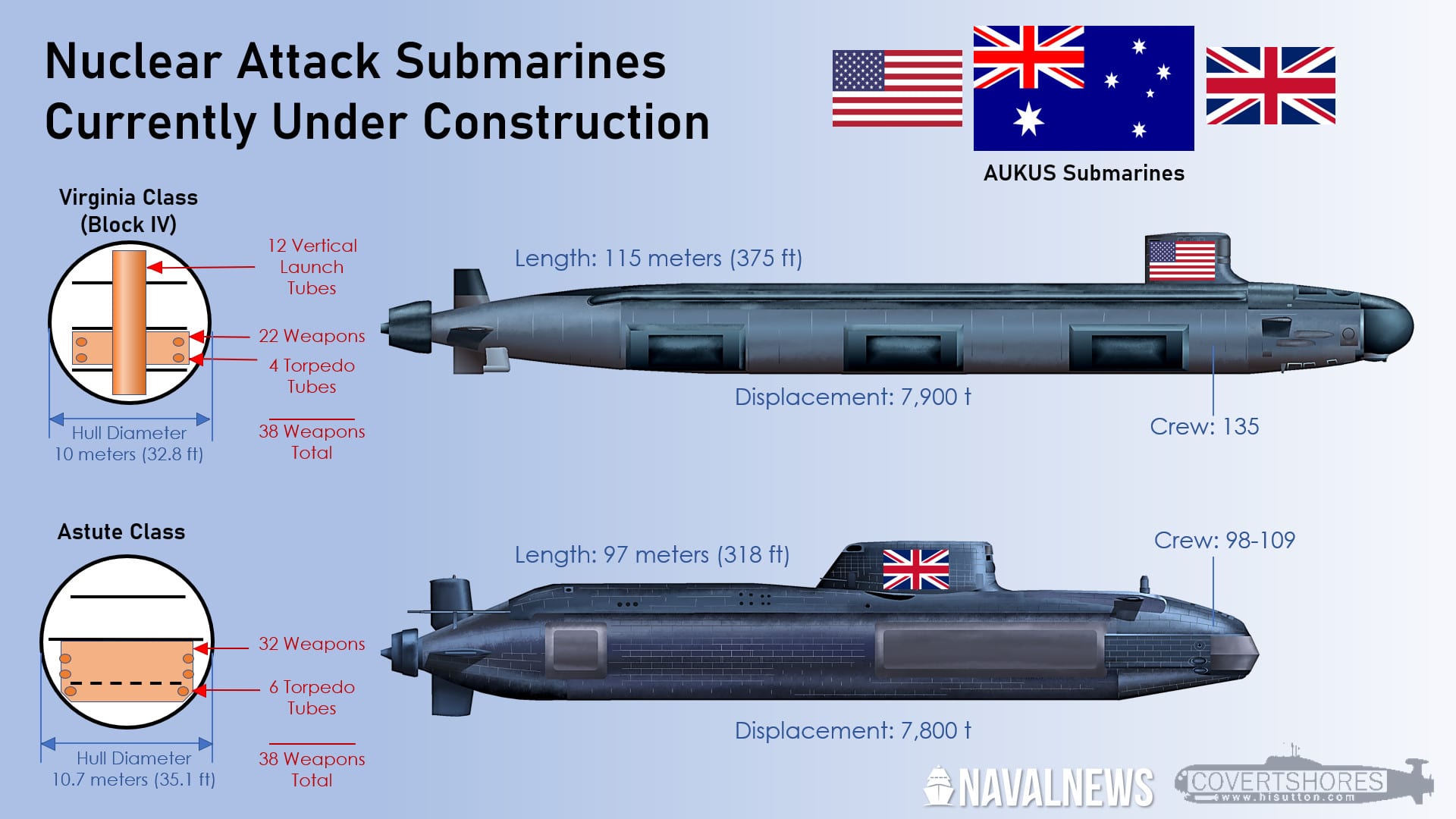
the new trilateral partnership with Britain and the United States to
help build Australia a fleet of nuclear-powered submarines as a
“brilliant stroke,” in particular with respect to the shared regional
challenge posed by China’s navy. But he also underlined all the
attendant difficulties of the enterprise by cautioning that “this is a
very long-term effort that’ll be decades before the [first] submarine
goes in the water.”
Aside
from the expense and difficulty of building the actual submarines,
creating the required industrial and institutional infrastructure to
support a fleet of nuclear submarines, and developing the cohort of
people needed to operate, maintain, and repair them, is itself an
extraordinarily complex, expensive, and lengthy endeavor. Admiral Mike
Gilday, head of the U.S. Navy, recently praised
the new trilateral partnership with Britain and the United States to
help build Australia a fleet of nuclear-powered submarines as a
“brilliant stroke,” in particular with respect to the shared regional
challenge posed by China’s navy. But he also underlined all the
attendant difficulties of the enterprise by cautioning that “this is a
very long-term effort that’ll be decades before the [first] submarine
goes in the water.”
 Kono’s
support for a nuclear submarine fleet, at least conceptually, if not
actually, could be partly a response to hawkish positions taken by his
rivals. Takaichi Sanae, a conservative contender for the LDP leadership,
was also supportive of the idea of Japan procuring nuclear-powered
submarines at the forum. She had earlier gained attention at a similar
candidate event by announcing her support for the potential deployment of long-range U.S. missiles on Japanese territory.
Kono’s
support for a nuclear submarine fleet, at least conceptually, if not
actually, could be partly a response to hawkish positions taken by his
rivals. Takaichi Sanae, a conservative contender for the LDP leadership,
was also supportive of the idea of Japan procuring nuclear-powered
submarines at the forum. She had earlier gained attention at a similar
candidate event by announcing her support for the potential deployment of long-range U.S. missiles on Japanese territory.
When the United States left the Cold War-era INF treaty in 2019 it was freed from restrictions that had limited the range of its ground-based missiles to less than 500 kilometers. Once freed from those restrictions, the Pentagon quickly announced initiatives to produce new long-range missiles to counter China’s own extensive arsenal, but the United States’ regional partners were all reluctant to support deploying those weapons to their territory and potentially making themselves the target of a preemptive Chinese attack in the event of a conflict with the United States.
 Japan
currently operates the world’s fourth-largest modern submarine fleet
with 22 boats, behind China, the United States, and Russia (Iran and
North Korea also have large submarine fleets, but operate smaller,
outdated, and far less capable vessels). Unlike the other top submarine
fleets, Japan’s is entirely conventionally powered with advanced
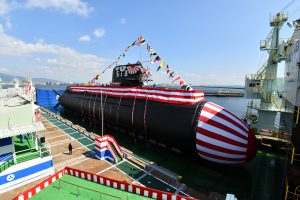
diesel-electric drive systems. Its latest design,
the Taigei-class, was launched in 2020, and features new lithium-ion
batteries to store the electric power the submarine uses when submerged.
Two more of the advanced class are expected to enter service in the
next few years.
Japan
currently operates the world’s fourth-largest modern submarine fleet
with 22 boats, behind China, the United States, and Russia (Iran and
North Korea also have large submarine fleets, but operate smaller,
outdated, and far less capable vessels). Unlike the other top submarine
fleets, Japan’s is entirely conventionally powered with advanced
diesel-electric drive systems. Its latest design,
the Taigei-class, was launched in 2020, and features new lithium-ion
batteries to store the electric power the submarine uses when submerged.
Two more of the advanced class are expected to enter service in the
next few years.
Japan is increasingly concerned about China’s belligerent rhetoric and assertive military posture and is modernizing its naval aviation and expanding its capabilities to launch long-range missile attacks in response. Japan has also dramatically increased its open support for Taiwan’s security and defense.


No comments:
Post a Comment
Note: Only a member of this blog may post a comment.