
 Posts
Posts


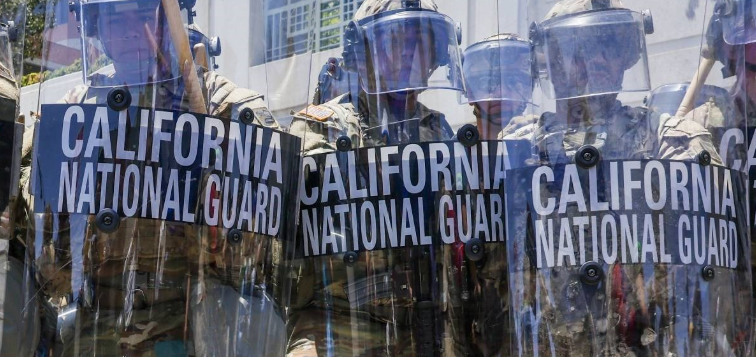
Presidents have called on the National Guard dozens of times since the nation's inception to respond to "civil unrest," it wasn't until 1967 that presidents federalized the Guard to further assist law enforcement agencies responding to protests and demonstrations.
The earliest instances of presidents sending the Guard in to quell civil unrest are in 1794 and 1799, when Presidents George Washington and John Adams called upon state militia and volunteer units to suppress the Whiskey Insurrection and Fries’ Rebellion.
After the intervention of President Dwight Eisenhower, federal forces, including the 101st Airborne Division, are sent to Arkansas to repel racial segregation and protect the nine Black students attending the Central High School of Little Rock on September 25, 1959.
 The Stand in the Schoolhouse Door took place at Foster Auditorium at the University of Alabama on June 11, 1963. In a symbolic attempt to keep his inaugural promise of "segregation now, segregation tomorrow, segregation forever" and stop the desegregation of schools, George Wallace, the Democratic Governor of Alabama, stood at the door of the auditorium as if to block the way of the two African American students attempting to enter: Vivian Malone and James Hood.
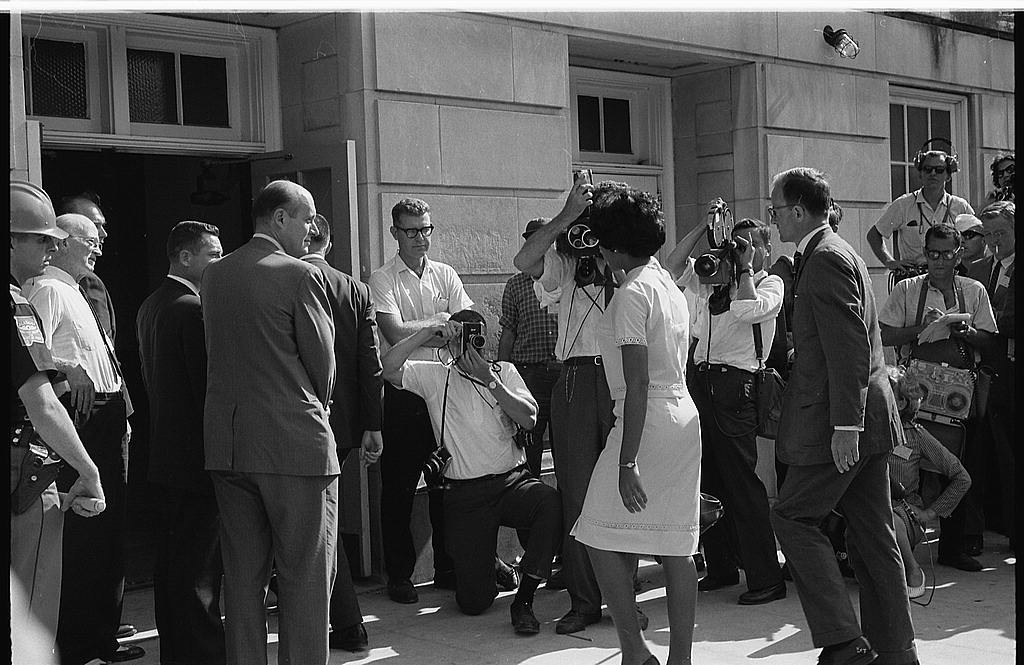 In response, President John F. Kennedy issued Executive Order 11111, which federalized the Alabama National Guard, and Guard General Henry V. Graham then commanded Wallace to step aside. Wallace spoke further, but eventually moved, and Malone and Hood completed their registration. The incident brought Wallace into the national spotlight.
President Lyndon B Johnson had called in National Guard troops without a state governor's permission in 1965.
 At that time, president Lyndon B Johnson stepped in, in an effort to protect civil rights protesters as they marched in Selma, Alabama. Civil rights organisations had converged for a march from Selma to Montgomery, Alabama, calling for federal protection of voting rights.
Governor George W. Romney ordered the Michigan Army National Guard into Detroit to help end the disturbance. President Lyndon B. Johnson sent in the United States Army's 82nd and 101st Airborne divisions. The riot resulted in 43 deaths, 1,189 injured, over 7,200 arrests, and more than 400 buildings destroyed.
 President George W. Bush in 1992 called on Guard members to respond to the 1992 Rodney King riots, which broke out after the acquittal of the Los Angeles Police Department officers who beat Black motorist Rodney King. The unrest left 60 people dead and 2,300 injured,
  thousands of members of the Guard, the U.S. Army and the Marine Corps were deployed in the city.


No comments:
Post a Comment
Note: Only a member of this blog may post a comment.