Germany’s decision to deploy a permanent force of 5,000
soldiers to Lithuania is extremely significant because it signals the
next phase of a new geopolitical era. One of the most fundamental
questions of this era is the extent to which the U.S. will limit its
military and financial exposure to the global system. Toward that end,
Washington has demanded that Europe assume primary responsibility for
its own security and has made initial attempts to reshape the
international economic order that had been in place since World War II
to facilitate the change. We have been waiting to see how Europe reacts.
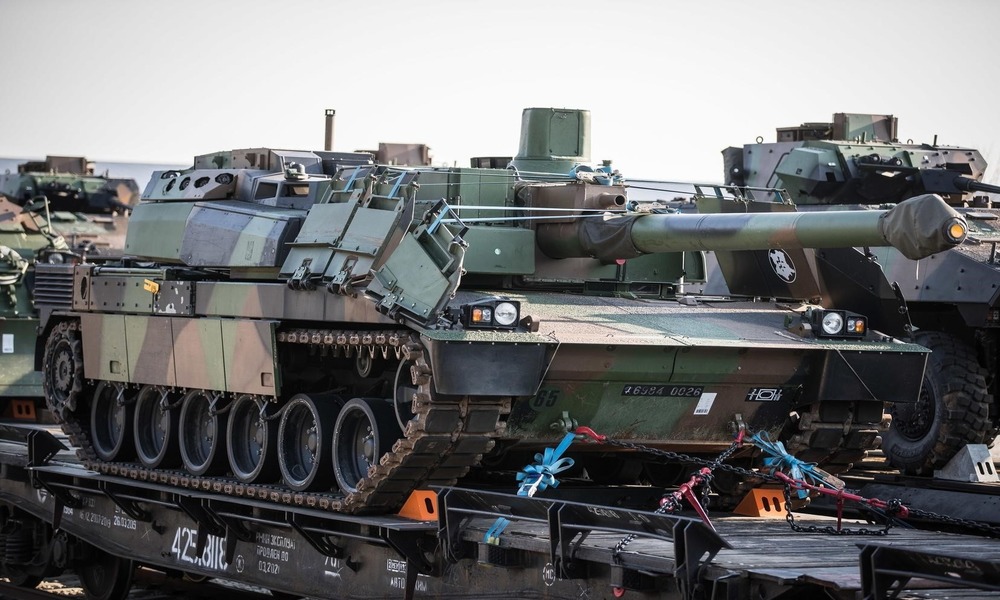 The German deployment is the first response. The size of the
deployment is not designed to resist a full Russian attack, of course,
but it is meant to trigger a massive response in Europe and instill a
sense of caution in Russia. With Germany having thus created a concrete
military commitment in Europe, the question now is whether the
deployment is the first of many European actions or simply a solitary
act. As I have argued, Europe is merely the name of the Continent, a
landmass slightly larger than the continental U.S. comprising 44
sovereign states. A coordinated European response means one thing; 44
individual responses would mean quite another. Similarly, it will be
important to see not how the entirety of NATO responds but how the
United Kingdom, Germany, France and Poland – the alliance’s strongest
and most geographically relevant members – respond. Though it remains
unlikely that they would permanently place military forces in positions
to block a westward Russian attack, the Ukraine war has made the
prospect possible.
The German deployment is the first response. The size of the
deployment is not designed to resist a full Russian attack, of course,
but it is meant to trigger a massive response in Europe and instill a
sense of caution in Russia. With Germany having thus created a concrete
military commitment in Europe, the question now is whether the
deployment is the first of many European actions or simply a solitary
act. As I have argued, Europe is merely the name of the Continent, a
landmass slightly larger than the continental U.S. comprising 44
sovereign states. A coordinated European response means one thing; 44
individual responses would mean quite another. Similarly, it will be
important to see not how the entirety of NATO responds but how the
United Kingdom, Germany, France and Poland – the alliance’s strongest
and most geographically relevant members – respond. Though it remains
unlikely that they would permanently place military forces in positions
to block a westward Russian attack, the Ukraine war has made the
prospect possible.
 But even if Germany’s was a solitary act, it is a critical shift in
Europe. The country has been a pariah state, albeit to a decreasing
extent, since World War II – arguably, since World War I. It initiated
combat in both wars, against countries that are now members of NATO,
against countries now outside the alliance and, crucially, against the
Soviet Union. It emerged from World War II not as a sovereign nation but
as a divided territory, occupied by both the West and the Soviet Union
until the 1990s. After it was reunited, it quickly became the
Continent’s economic center of gravity. And though its economic weight
makes it the first among equals in the EU, it has been careful to avoid
asserting military power. Europe has a long memory, and for centuries,
its history was the history of all-against-all warfare. Germany’s
decision to deploy troops in Europe – which has been welcomed by the
U.S. as well as other European countries – violates its commitment to
modest ambitions for European leadership. Put simply, the deployment to
Lithuania could presage the reemergence of Germany as a geopolitical
force. Had the U.K., France or Poland made the military commitment, we
likely wouldn’t bat an eye. But it was Germany that did, so now Europe
will have to consider not just what the U.S. wants but also what Germany
may become. It’s possible that the fear of German power is obsolete,
but I suspect it isn’t.
But even if Germany’s was a solitary act, it is a critical shift in
Europe. The country has been a pariah state, albeit to a decreasing
extent, since World War II – arguably, since World War I. It initiated
combat in both wars, against countries that are now members of NATO,
against countries now outside the alliance and, crucially, against the
Soviet Union. It emerged from World War II not as a sovereign nation but
as a divided territory, occupied by both the West and the Soviet Union
until the 1990s. After it was reunited, it quickly became the
Continent’s economic center of gravity. And though its economic weight
makes it the first among equals in the EU, it has been careful to avoid
asserting military power. Europe has a long memory, and for centuries,
its history was the history of all-against-all warfare. Germany’s
decision to deploy troops in Europe – which has been welcomed by the
U.S. as well as other European countries – violates its commitment to
modest ambitions for European leadership. Put simply, the deployment to
Lithuania could presage the reemergence of Germany as a geopolitical
force. Had the U.K., France or Poland made the military commitment, we
likely wouldn’t bat an eye. But it was Germany that did, so now Europe
will have to consider not just what the U.S. wants but also what Germany
may become. It’s possible that the fear of German power is obsolete,
but I suspect it isn’t.
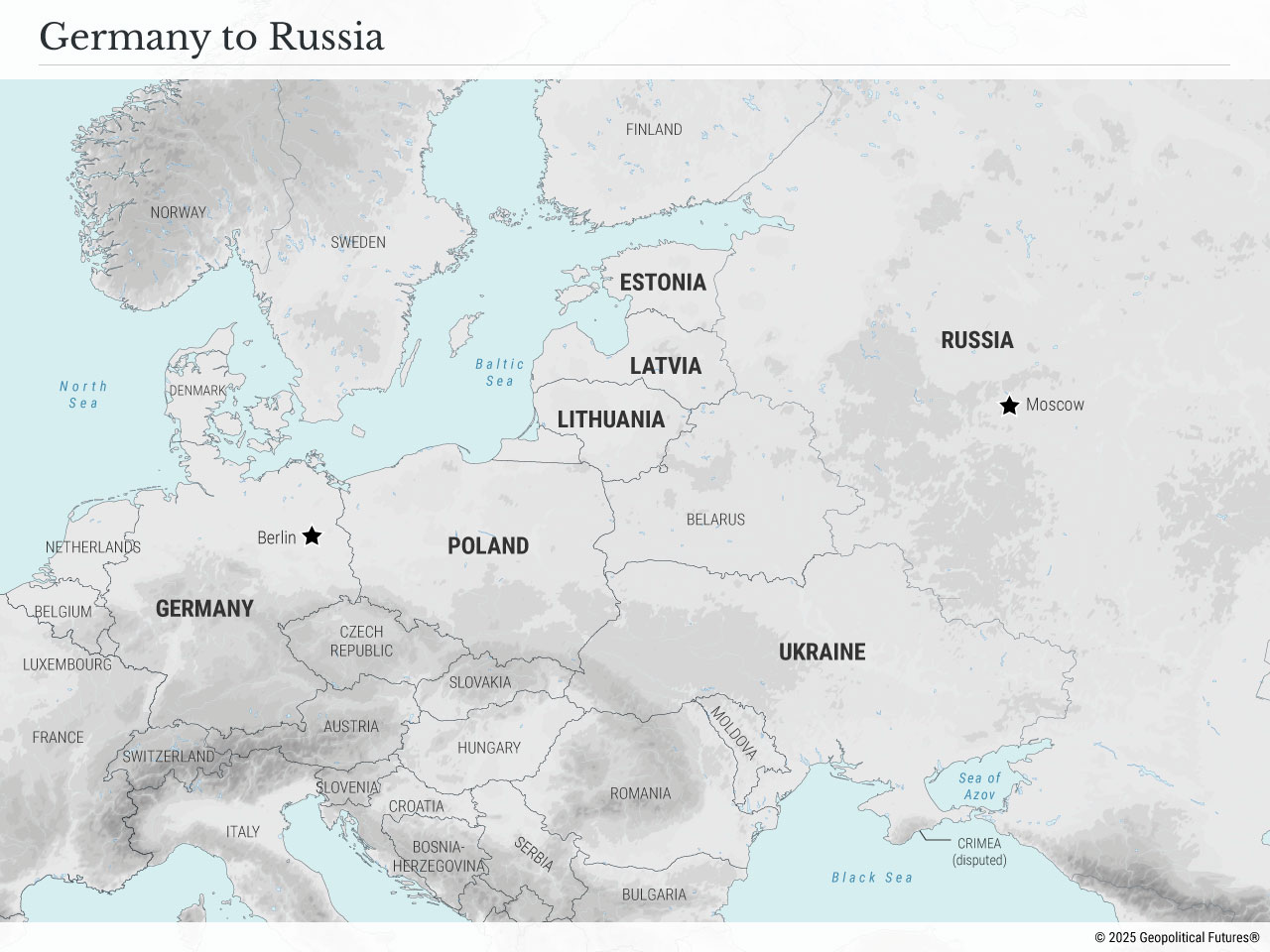
There is, meanwhile, the Russian question that must also be
considered. The decision to send troops to Lithuania was well thought
out strategically. Lithuania borders Latvia, Poland and Belarus; it has
no border with Russia or Ukraine. In the event, say, Russia moves
rapidly to occupy Ukraine and then retake the nations that had been part
of the Soviet Union, or moves to reclaim influence in the European
satellites it once occupied, a German armored brigade based permanently
in Lithuania would raise the stakes. Again, a single German brigade
wouldn’t stop the full weight of the Russian military, but the attack on
Lithuania through Belarus would raise the risk of a NATO, and thus
U.S., intervention. It’s a prime location to place troops and drive home
to Russia the risks expansionism would carry. At the same time, neither
Germany nor Lithuania borders Ukraine, so Moscow can’t see this as a
military threat to Ukraine, nor can it threaten Lithuania without first
showing its hand to other countries. This gives NATO, Europe and the
United States time to react.
Germany may have also provided a blueprint for European self-defense:
Deploying troops into forward positions near but not on the Russian
border will show that actions beyond Ukraine will give European
countries a chance to act quickly while still giving NATO options to
respond. (As I have said before, it may seem crazy to think that Russia
would venture past Ukraine today, but countries don’t make long-term
strategic plans hoping for the best.)
The U.S. decision to recuse itself from European security has created
a crisis on the Continent. Fortunately for Europe, U.S. measures to
that end have been so far rhetorical; for all its bluster, the U.S. has
not withdrawn troops from NATO, and it has yet to clarify the precise
nature of its comments. Still, nations are nations, and they will act in
their own interest as such. An alliance like NATO exists only when
nations see the world in the same way. Germany’s deployment could force
Europe to decide what to do – and not deciding is a decision. The shock
to Europe has generated the kind of response it wanted. Germany may be
likely to be emulated, but given history, it is unlikely to be allowed
to lead. The Europeans have long memories.

 Posts
Posts