Motown Spotlight: Marvin Gaye: ‘Here, My Dear’
next month we celebrate the forty-fifth anniversary of one of his most significant albums, “Here, My Dear”.
While riding on the success of the million-selling, number one single
“Got To Give It Up (Parts I and II)”, the only studio track from his
“Live! At The London Palladium” in May 1977, Marvin was served with
divorce papers by his estranged wife Anna claiming irreconcilable
differences, and child support for their adopted son Marvin Gaye III,
born to Berry Gordy’s niece Denise. Anna knew Marvin was penniless, yet
asked for $1 million. The eventual settlement was quite unique because
Marvin’s lawyer, Curtis Shaw, convinced Marvin to pay a total of
$600,000 to his wife from the proceeds of his next album. (The sum
would be made up from the advance: $305,000 and album’s earnings:
$305,000) Anna really had no choice but to agree; the divorce was
granted on those terms, leaving Marvin free to marry Janis Hunter, whom
he had met in March 1973 while he was working on the “Let’s Get It On”
album.
 Jan, the daughter of jazz musician Slim Gaillard, went on to have two
children with Marvin, namely, Nona born in September 1974, and Frankie
in November a year later. Then in October 1977, Marvin and his young
bride married in a secret ceremony in New Orleans. His friends and
family felt the union would stabilise him, encouraging him to become
more reliable in his working environment. For his part, Marvin said the
marriage had made his relationship with Janis different; he felt it was
deteriorating, yet prior to this they had enjoyed each other with all
the romance that went towards taking their marriage vows. Jan rose
above all the complications thrown at her to cope with her husband’s
continuing idiosyncrasies and, often shoddy behaviour, while he told the
media, “There are a lot of things I desire. I desire peace and
happiness and love and understanding. That sounds ridiculous to a lot
of people. ‘Who is this guy wanting all that?’ Another trouble maker.”
Jan, the daughter of jazz musician Slim Gaillard, went on to have two
children with Marvin, namely, Nona born in September 1974, and Frankie
in November a year later. Then in October 1977, Marvin and his young
bride married in a secret ceremony in New Orleans. His friends and
family felt the union would stabilise him, encouraging him to become
more reliable in his working environment. For his part, Marvin said the
marriage had made his relationship with Janis different; he felt it was
deteriorating, yet prior to this they had enjoyed each other with all
the romance that went towards taking their marriage vows. Jan rose
above all the complications thrown at her to cope with her husband’s
continuing idiosyncrasies and, often shoddy behaviour, while he told the
media, “There are a lot of things I desire. I desire peace and
happiness and love and understanding. That sounds ridiculous to a lot
of people. ‘Who is this guy wanting all that?’ Another trouble maker.”
 Obviously marriage didn’t suit him because he failed to adapt easily
to a committed family life, and spent much time away from his home,
using a variety of excuses. Although his divorce from Anna was settled
in principle, he still had to honour the financial commitment as decreed
by the court. Added to this financial burden, bankruptcy charges had
been instigated against him from which he had no escape. Curtis Shaw
told Rolling Stone magazine that he attributed the singer’s
disastrous plight to hiring unqualified friends and members of his
family: “He delegated duties to people who were incompetent. I couldn’t
even get Marvin to hire an accountant. In fact, the Federal Bankruptcy
Judge told Marvin in court, ‘Mr Gaye, we are all working hard to get
you out of this terrible trouble but I already know the pattern.’”
Obviously marriage didn’t suit him because he failed to adapt easily
to a committed family life, and spent much time away from his home,
using a variety of excuses. Although his divorce from Anna was settled
in principle, he still had to honour the financial commitment as decreed
by the court. Added to this financial burden, bankruptcy charges had
been instigated against him from which he had no escape. Curtis Shaw
told Rolling Stone magazine that he attributed the singer’s
disastrous plight to hiring unqualified friends and members of his
family: “He delegated duties to people who were incompetent. I couldn’t
even get Marvin to hire an accountant. In fact, the Federal Bankruptcy
Judge told Marvin in court, ‘Mr Gaye, we are all working hard to get
you out of this terrible trouble but I already know the pattern.’”
 With all this pressure on him, Marvin was in no mood to complete what
he called his “divorce settlement” album, later confirming that he had
deliberately taken his time, not because of Anna, but due to a new spate
of disagreements with Motown. “I was involved in some political
fighting with (them) and then (when) the Federal Court felt the album
was part of my estate for bankruptcy, I thought I’d put out a lot of
garbage for the album because all I had to give was one album. There
was no stipulation that it had to be a good one, so Anna was taking her
chances here.”
With all this pressure on him, Marvin was in no mood to complete what
he called his “divorce settlement” album, later confirming that he had
deliberately taken his time, not because of Anna, but due to a new spate
of disagreements with Motown. “I was involved in some political
fighting with (them) and then (when) the Federal Court felt the album
was part of my estate for bankruptcy, I thought I’d put out a lot of
garbage for the album because all I had to give was one album. There
was no stipulation that it had to be a good one, so Anna was taking her
chances here.”
![Marvin Gaye - Here, My Dear [2 LP] - Amazon.com Music](https://m.media-amazon.com/images/I/61bGIUhx56L._UF1000,1000_QL80_.jpg) However, part way through the recording sessions at his studio, he
changed his mind. “I thought of my fans when I started recording. The
more I cut, the more I got involved. After a certain point I forgot I
was mad and angry, and did some decent work. The result was, I think,
pretty fair. I listened to it for over a year and I felt poor when I
realised I wasn’t going to make any money from it.”
However, part way through the recording sessions at his studio, he
changed his mind. “I thought of my fans when I started recording. The
more I cut, the more I got involved. After a certain point I forgot I
was mad and angry, and did some decent work. The result was, I think,
pretty fair. I listened to it for over a year and I felt poor when I
realised I wasn’t going to make any money from it.”
It was a pretty hefty pay-off for a divorce particularly as Marvin
speculated, but never confirmed, that Berry Gordy bankrolled his
sister’s court case against him. Uncharacteristically, Marvin wasn’t
bitter about the actual action, but rather disagreed with the whole
legal structure of divorce proceedings as a whole. He said at the time
that while he liked the institution of marriage, this album reflected
the reverse: “There’s a terrible imbalance with the whole divorce thing
and I don’t like it. It doesn’t matter who’s right or wrong, the man
must pay the wife everything. Pay for the divorce and give over to her
the custody of the children, and yet the man can still take care of his
child because a father can be a mother too. American law cannot see
that and it’s horrible.”
 “Here,
My Dear” was simultaneously released in America and Britain during
December 1978 because when Motown /EMI was notified of the pending US
release date, it immediately shipped in five thousand copies to sell
with over-stickered UK record prefixes to stem import sales which
wouldn’t be registered as British sales, thus losing valuable chart
points. British pressings were then made available under the deluxe TMSP
series when those imports were exhausted.
“Here,
My Dear” was simultaneously released in America and Britain during
December 1978 because when Motown /EMI was notified of the pending US
release date, it immediately shipped in five thousand copies to sell
with over-stickered UK record prefixes to stem import sales which
wouldn’t be registered as British sales, thus losing valuable chart
points. British pressings were then made available under the deluxe TMSP
series when those imports were exhausted.
Containing his cynical, personal statements, often intimate details
about his two wives, it was often difficult for the listener to
distinguish the difference between the two. The thematic work was
devoted to discovering and sharing love, the loss of that love, with the
bitterness and pain caused by that loss. In other words, it was the
breakdown of a fourteen-year-old marriage and of the joy in discovering a
new young love. So, due to its personal nature, “Here, My Dear” was all
his own work (although this was later disputed) with the exception of
three tracks, namely, “Sparrow” and “Everybody Needs Love” which he
wrote with Ed Townsend, and “Anger” penned with Townsend and Delta
Ashby. Quite possibly more people were involved than the three
mentioned, but all Marvin would say on the subject was, “The album was
recorded under a certain amount of strain and I don’t like to work under
those conditions. It was a painful necessity, best done and best
forgotten.” During a conversation with (the late) London DJ, Graham
“Fatman” Canter, Marvin told him,“At least I’ve got the album away. Let
her have her money.”
A high percentage of Marvin Gaye fans were appalled with the
concept; they were tired of his self-inflicted depression, the
impassive songs of doom, and once again longed for another “What’s Going
On” or, better still, those glorious, carefree sounds of the sixties. I
think my colleague Cliff White’s review in 1978 was generously
thoughtful: “On the first few hearings it doesn’t seem to be a wholly
commendable album; over-sentimental in some places, carelessly padded in
others. But when it’s good, it’s very good, especially if we’re to
assume it’s all straight from the
bleeding-heart-Marvin-Gaye-tells-it-like-it-is sensation.” Britain’s The Daily Mirror
critic stated,“It’s not as original or inventive as some of his earlier
works.” Yes, the media was confused, somewhat cynical in its opinions,
and this was reflected by his fans. For me, it took a long while to get
into Marvin’s mind set, and while I liked much of what I heard, I was
saddened that he decided to wash his dirty linen in public.
 As
an aside here: when he had finished the album, Marvin insisted Anna
visit the studio to hear the songs. She held a dignified silence.
“Anna is a very beautiful person….she’s great….and it was a very painful
and bitter situation that left me somewhat frustrated and beaten a
bit….I just felt I’d write about what was true….I would not like to
suggest this would hurt Anna because I’d love to see some happiness in
her life.”
As
an aside here: when he had finished the album, Marvin insisted Anna
visit the studio to hear the songs. She held a dignified silence.
“Anna is a very beautiful person….she’s great….and it was a very painful
and bitter situation that left me somewhat frustrated and beaten a
bit….I just felt I’d write about what was true….I would not like to
suggest this would hurt Anna because I’d love to see some happiness in
her life.”
Marvin’s audacity to share with the world such private thoughts, then
say he didn’t want to hurt her really beggars belief, doesn’t it?
Personally, I would have knocked him senseless! Why couldn’t he have
done the decent thing and chosen another topic to write about? However,
perhaps a little in Marvin’s defense, he did outline both sides of
their marriage: the bitter tracks that stung and the respectful ones
that portrayed their love. “The trouble with marriage is that one has
to put up with little differences and it’s these things you have to look
out for because they eventually become monumental things…..If one’s
mate isn’t really of the same mind and feeling, then I can’t see it
working. And my way of thinking is such that I wouldn’t ask any other
person to adapt to my lifestyle.”
So, let’s delve further into the music. To ensure nobody was in any
doubt why the double album was recorded Marvin introduced the listener
with a message to Anna which went something like, “I guess I have to
say this album is dedicated to you…Although perhaps I may not be happy,
this is what you want, so I have conceded….I hope it makes you
happy…There’s a lot of truth in it baby…I don’t think I’ll have any
regrets baby.” He then continued with a somewhat stinging attack about being prevented from seeing his son before adding: “So
here it is, enjoy, reminisce, be happy, think about the kisses and
joy…the other times cloudy and grey….think of me, the way I was. This
is what you wanted, here, my dear. Here it is.”
Thus began a resume of the marriage breakdown, starting with a
mellow, moody “I Met A Little Girl” where he chronologically revealed
his time with Anna: when they first met, their marriage and subsequent
divorce, his fantasy woman who turned into reality and the promises they
sealed with the love that was strong enough to stand the test of time.
Marriage vows were sacred and eternal, he said, which introduced the
lengthy “When Did You Stop Loving Me, When Did I Stop Loving You”, a
slightly more aggressive song both musically and vocally. It was here
that Marvin attempted to unravel the spider’s web that led to the
marriage breakdown and why should he be the one shouldering a $1 million
debt. “Lies And Ties” was the theme of this rather self-indulgent
cross-examination, until “Anger” took over, a lightweight, slightly
offbeat funky song, overflowing with the most powerful of emotions. In
my opinion, his dissection was unsatisfactory.
Flipping the original vinyl, side two kicked off with “Is That
Enough|” which dealt with jealousy and possessiveness, and Marvin’s
inability to accept the decision laid down by the divorce judge. His
drug addiction was mentioned briefly, prior to a sultry brass solo
leading into a lengthy instrumental section. “Everybody Needs Love”,
was a testament to those he felt would benefit from love irrespective of
their standing in life, while “Time To Get It Together” predictably
dealt with his favourite subject, albeit a subdued reference this time.
“Sparrow” opened the next disc, a poignant tale of his
wise-and-weathered feathered friend, against a strong melody where the
lazy, often cumbersome horns almost ruined the song. Not so “Anna’s
Song”: “baths of milk, satin sheets, all night love” – a tender
song of reflection. Disc four started with the jazz/funk “A Funky
Space Reincarnation” followed by the biting yet lacklustre “You Can
Leave, But It’s Going To Cost You”. In the track Marvin exposed his
meetings at Anna’s sister Gwen’s house, where they thrashed out their
problems; the familiar story of attempted reconciliation and the high
price of freedom. And lastly, after the break-up the “Falling In Love
Again”, with the joys of re-discovering love, including references to
Janis like “she’s pretty, she’s wonderful.”
At this point, listeners were crumbled in a heap, particularly if the
four discs were played in one session. I remember saying to a
colleague, that while I sympathised with the deal Marvin had been given,
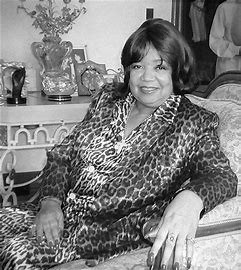
my thoughts were with his ex-wife, even though we had never met. Years
later, I had a quick phone chat with her, and had hoped for more. Very
sadly, Anna died in January 2014, three days after her ninety-second
birthday.
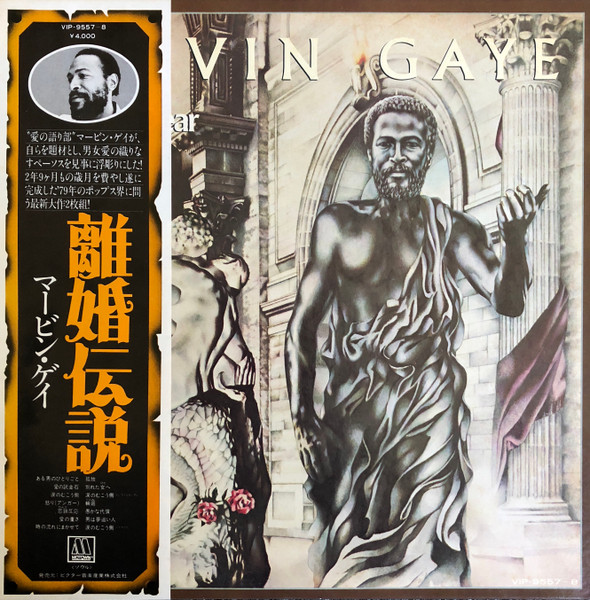
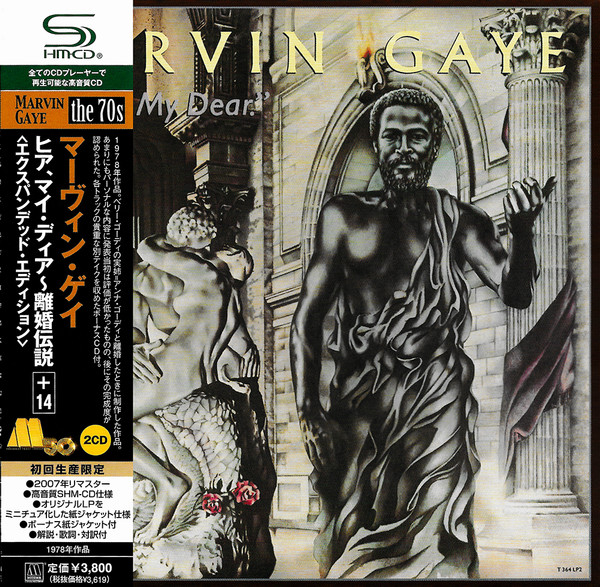
The gatefold double album packaging was a stark clash of emotions.
Like “I Want You” before it, the colouring was dull, dark, punctuated by
splashes of insipid red. When flattened, the sleeve showed a neo-Roman
setting, where fire burned and blood stains streaked the walls, while
Rodin’s The Kiss was pictured with a pair of pink roses at the
statue’s base. A black statue of Marvin wearing a toga stood in the
foreground. Behind these, two plaques were etched into facing walls;
one reading “Pain And Divorce”, the other “Love And Marriage”.
 The
dramatic scene, drawn by Michael Byran from Marvin’s instructions, was a
confusing clash of good and evil, and I’m sure some will agree, a
pictorial indication of Marvin’s imaginative yet disturbed mind.
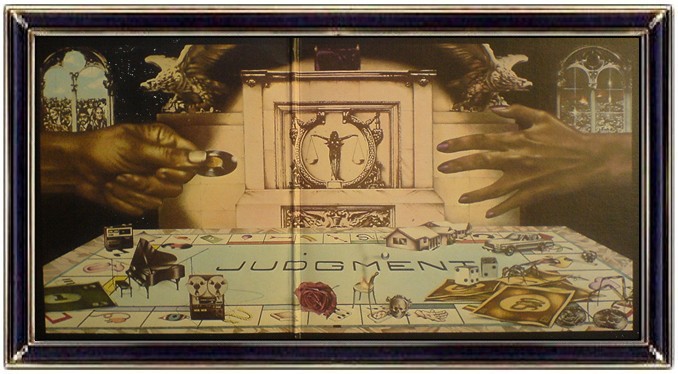
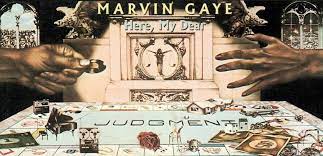
Michael was also responsible for the inner sleeve depicting a “Monopoly”
board game entitled Judgement. On the right, a red
finger-nailed hand hovers over a pile of $500 bills, a couple of coins, a
mansion, a limousine, two dice, insects and a dress ring. On the left, a
hand clutches a record, under which is a Revex tape machine, a piece of
recording equipment, a grand piano and a single dollar bill.
The
dramatic scene, drawn by Michael Byran from Marvin’s instructions, was a
confusing clash of good and evil, and I’m sure some will agree, a
pictorial indication of Marvin’s imaginative yet disturbed mind.
Michael was also responsible for the inner sleeve depicting a “Monopoly”
board game entitled Judgement. On the right, a red
finger-nailed hand hovers over a pile of $500 bills, a couple of coins, a
mansion, a limousine, two dice, insects and a dress ring. On the left, a
hand clutches a record, under which is a Revex tape machine, a piece of
recording equipment, a grand piano and a single dollar bill.
The album’s most commercial track, “A Funky Space Reincarnation” –
where Marvin sings of a future parallel universe (he’s the captain of a
“space bed” and meets a woman that reminded him of Anna) – was issued
as a single. It struggled for sales. So much so, that the proposed
follow-up “Anger” was withdrawn. Marvin’s career had taken a huge
knock. He blamed Motown. However, thinking logically, there’s little
doubt that “Here, My Dear” widened the already growing gap between the
singer and Berry Gordy, who was obviously saddened at the albums’
content. The trouble was, the next album “In Our Lifetime” was another
musical catastrophe, born from frustration and resentment, with a
handful of bright moments.
I feel it’s worth mentioning this: during the eighties, Marvin and
Anna reconciled as friends. In fact, she accompanied him to industry
events after the release of his first and only CBS album “Midnight Love”
during 1982. She also went as his guest to the Grammy Awards ceremony a
year later when Marvin collected two golden statuettes. When he died
in 1984, Anna was heartbroken. Then ,she and his three children
scattered most of his ashes near the Pacific Ocean, while she kept a
small portion for herself. Anna never re-married.
Sharon Davis
(PS: “Here, My Dear” was re-released in 1994 to reach number one in
the US R&B chart. In 1995 it was voted as one of the greatest albums
in music history by Mojo magazine, and has appeared in all three “The 500 Greatest Albums of All Time” listing in Rolling Stone magazine.
In 2008, the album was re-issued as a two-disc Expanded Edition, and
included “Ain’t It Funny How Things Turn Around”, a leftover track from
the original sessions.)

 Posts
Posts