
 Posts
Posts


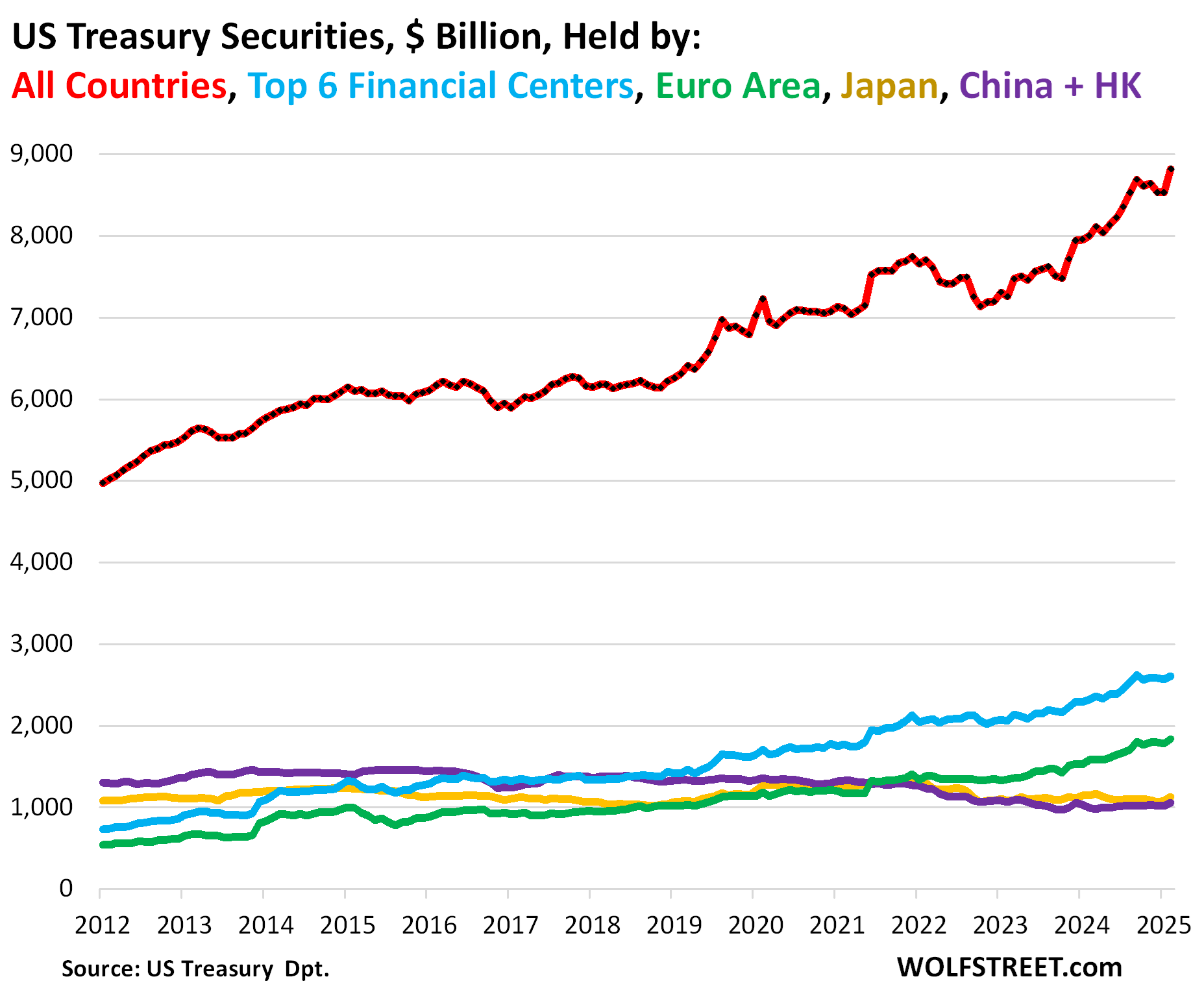
Foreigners boost US Treasury holdings to record highs in February
NEW
YORK, April 15 (Reuters) - Foreign holdings of Treasuries climbed to a
record high in February, data showed on Wednesday, rising for a second
month in a sign of strong appetite for U.S. debt even as markets
reassess the outlook for the Federal Reserve's interest rate policy.
Holdings
by foreigners rose to $9.49 trillion in February, up 2.1% from $9.29
trillion in the previous month, data from the Treasury Department
showed.
Compared
with a year earlier, Treasuries owned by foreigners were up 6.6%,
reflecting both falling yields early this year and the relative
attractiveness of U.S. returns compared with other developed markets.
The increase was led by Japan and the United Kingdom, the two largest foreign holders of U.S. government debt.
Japan
remained the biggest non-U.S. holder of Treasuries with holdings
rising to $1.239 trillion in February, its largest since February 2022
when its stash peaked at $1.303 trillion.
Japan's
holdings have advanced in 13 of the last 14 months, reflecting steady
demand from its institutions seeking higher yields overseas as local
rates remain low, with the Bank of Japan still trying to edge away from
ultra-loose policy.
Analysts say Japanese demand has also been supported by improved currency-hedged returns.
The
UK, the second-largest owner of Treasuries, also raised its holdings to
$897.3 billion, up 2% from January. The UK is widely viewed as a major
custody hub for global investors and flows there are often seen as a
proxy for hedge fund positioning.
China,
the third-biggest foreign holder of Treasuries, slightly pared
holdings to $693.3 billion in February. China's stock of Treasuries has
declined by 9% since January 2025, part of a longer-term trend of
diversification away from U.S. assets amid geopolitical tensions and
efforts to deploy reserves into other currencies and investments.
February's
increase in foreign demand coincided with a decline in benchmark
10-year Treasury yields over the month from around 4.277% to 3.962%.
Overall,
the data showed net capital inflows of $184.5 billion in February,
after posting preliminary net outflows of $25 billion in January.
Monthly
net capital flows could remain volatile, reflecting the fallout on
market sentiment from the U.S.-Israeli war with Iran, which began on
February 28.


No comments:
Post a Comment
Note: Only a member of this blog may post a comment.