5 Takeaways From China’s Big Leadership Announcement
The 20th Party Congress has closed, with Xi Jinping’s grip on power even tighter than expected.
After years of speculation, the 20th Party Congress has closed, and
the new Central Committee elected the members of the Politburo Standing
Committee, the men who will rule China for the next five years. Xi Jinping, of course, is the ultimate ruler; he is joined on the PSC by Li Qiang (presumed to be the next premier, although that won’t be official until the National People’s Congress session in March 2023); Zhao Leji (presumed chair of the National People’s Congress, to be announced in March); Wang Huning (presumed chair of the CPPCC, also to be announced in March), Cai Qi (leader of the CCP’s Central Secretariat); Ding Xuexiang (presumed executive vice premier, to be announced in March), and Li Xi (head of the Central Commission for Discipline Inspection).
Before the Party Congress, I highlighted five things to watch for
in the leadership selection. Let’s take a deeper look at those points
to see what the new leadership slate means for China and Chinese
politics moving forward. As a refresher, the PSC (seven members) is at
the top of the leadership pyramid, followed by the Politburo (24
members) and then the Central Committee (205 full members).
1. Xi Stays on as General Secretary
One
thing Xi didn’t do at this norm-breaking Party Congress was completely
upend the top leadership structure in order to reclaim the old “party
chairman” title. As I noted before, there was no doubt that Xi would
maintain control over the CCP; the only question was what form his
leadership would take. Some experts had speculated that Xi might try to
elevate himself above the PSC rather than merely being its undisputed
core. That would mean Xi’s taking the title of CCP chairman, once held
by Mao Zedong and Deng Xiaoping.
That didn’t happen; Xi retained the
position of general secretary and PSC member. Ultimately, with Xi
demonstrating his dominance over the current system, he had little
reason to want to change it.
2. Xi Loyalists Dominate the Politburo Standing Committee
The big question, as with each Party Congress, was who would make it onto the PSC. The answer: All Xi’s men.
In
order of their rank, Xi is joined by Li Qiang (aged 63, most recently
the party secretary of Shanghai); Zhao Leji (65, a holdover from the
previous PSC), Wang Huning (67, the other PSC incumbent to keep his
post), Cai Qi (66, most recently party secretary of Beijing), Ding
Xuexiang (60, most recently director of the Office of the General
Secretary and the Office of the President – essentially Xi’s chief of
staff); and Li Xi (66, most recently the party secretary of Guangdong
province).
Of these, the inclusions of Li Qiang and Cai Qi were
most surprising. Li Qiang, in particular, weathered a firestorm of
criticism for his handling of Shanghai’s COVID-19 outbreak and ensuing
lockdown. Not only did he still make it onto the PSC, but his rank
indicates that next March we should expect him to be named China’s
premier – despite Li having never held a national leadership position.
Li’s promotion thus breaks the longstanding precedent that the new
premier should have served a stint as vice premier. In effect, his
promotion sends a clear message that loyalty to Xi trumps, performance,
popularity, and experience.
The flip side to Xi’s dominance is
that no other political factions had a chance. Hu Chunhua, once seen as a
contender for the PSC, didn’t even make it back onto the Politburo,
although he did manage to hold on to a seat in the Central Committee.
Hu, who has been a vice premier for the last five years, was considered a
possible candidate for the next premier – but without Xi as a patron,
his career has effectively come to an end.
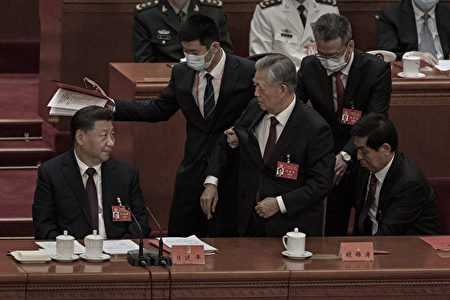
In fact, Hu Jintao,
Xi’s predecessor as China’s top leader and the leader of the main rival
political faction, was shockingly escorted offstage at the 20th Party
Congress, in full view of journalists. China’s state news agency Xinhua explained later
that Hu “was not feeling well,” so “his staff, for his health,
accompanied him to a room next to the meeting venue for a rest.”
(Notably, Xinhua posted the news, in English, on Twitter, which is
banned in China; there was no formal statement published in Chinese.)
But whether Hu was sick or the victim of a political purge, observers
noted his staged removal seemed calculated for maximum humiliation.
The
“image of Hu Jintao being led out is a perfect symbol of Xi’s absolute
decimation of [Hu’s] ‘Communist Youth League’ faction,” as China watcher
Bill Bishop, author of the “Sinocism” newsletter, wrote.
In the end, the 20th Party Congress fit the model – or even exceeded – Dan Macklin’s theorized “downside scenario.” And as Macklin wrote earlier this month, there will be consequences for China:
This institutional regression would also have worrying implications for policy direction. Surrounded by a coalition of weak
and loyal officials, Chairman Xi would face minimal resistance to
persisting with “zero COVID” or escalating corporate crackdowns. He
would become trapped in an authoritarian feedback loop, increasingly
unaware of the damage wrought by his own policies.
3. Age Limits Are No Longer Universal
In
order to pack the PSC with loyalists, Xi had to first break the
unwritten “seven up, eight down” age limit rule. Under this norm,
officials aged 68 or older at the time of a Party Congress must step
down, while those aged 67 or younger can be promoted or retain their
seats. As Ling Li pointed out in her analysis of the Party Congress as an institution,
this served as an important source of political stability: Top
officials knew they couldn’t be “forced” to retire, barring the tyranny
of age, and younger officials knew their elders wouldn’t hold seats in
perpetuity, preventing upward mobility within the CCP.
Now,
however, loyalty to Xi has replaced the age limit as the most important
condition of PSC membership. Incumbent PSC members Li Keqiang and Wang
Yang, both aged 67, have retired; both were from a rival political
faction. However, Xi ally Wang Huning, another 67-year-old PSC member,
got to retain his seat. The main criteria for one’s political career,
then, is no longer age but relationship to the “core” leader.
On
the broader Politburo, there were also a few age-related surprises. Wang
Yi, China’s foreign minister, was elevated to a Politburo seat, despite
being age 69. With the party’s former top diplomat, Yang Jiechi,
stepping down, Xi likely wanted an experienced foreign policy hand to
take Yang’s place – and aside from Wang Yi, there were few good options. So Xi bent the rules once again.
Similarly,
General Zhang Youxia, aged 72, stayed on the Politburo, meaning he will
also keep his seat as one of Xi’s vice chairs on the Central Military
Commission. Zhang’s family has longstanding ties to Xi, who likely
wanted to keep an unwavering ally in the top ranks of the People’s
Liberation Army.
As Ling Li noted, the danger of scrapping the age
limit is that each power succession becomes more fraught. Contenders
must fight not only to gain a seat on the Politburo or PSC but also to keep that
seat. As a result, Li warned, without age limits “the CCP would have to
face a serious ‘constitutional crisis’ regarding power succession at
the PSC in the future.”
4. No Successor for Xi
Speaking
of succession: Another takeaway from the PSC lineup is that there is no
obvious successor to Xi. Generally, a leader-in-waiting would be aged
in the mid-50s: young enough to serve a total of 15 years on the PSC
(one five-year term as a junior leader, learning the ropes, before
taking over the top slot for 10 years). But the youngest member of the
20th PSC is Ding Xuexiang at 60. Most analysts took this as a sign that
Xi is truly the leader for life.
But that doesn’t mean an end to
factional politics or political infighting. Indeed, Yang Zhang, an
assistant professor at American University specializing in political
sociology in China, noted that new factions are going to develop out of
the overarching “Xi faction,” as individual Xi loyalists curate their
own patronage networks. And these groups will continue to age-old
tradition of jostling for political power.
After all, Xi cannot
defeat his ultimate enemy: time. “His unlimited power will be
constrained by his limited capacity and decreasing energy as he turns
older,” Zhang told CNN.
Underlings will still be vying to succeed Xi behind the scenes, a
scenario that also played out as long-time leaders Mao Zedong and Deng
Xiaoping aged. The new factions that form under Xi will fight to pick up
any scrap of authority the “core” leader drops as he ages.
5. Asking Again: Where Are the Women?
As
I noted in my preview article, there has never been a woman in the PSC,
and that was not expected to change this year. But there was hope that
at least one woman would make it onto the Politburo, something we have
seen happen at each Party Congress since 1997.
That hope was
dashed – for the first time in 25 years, the Politburo doesn’t contain a
single woman. On the next level down, there are just 11 women among the
permanent members of the 20th Central Committee, accounting for 5.4
percent of seats.
As I wrote earlier, the performance of women has
meaning not only for this year’s Party Congress but for their future
prospects: No women on the Politburo this year means no woman even has a
chance to make the PSC at the 21st Party Congress in 2027. Likewise,
the small number of women in this year’s Central Committee does not bode
well for a woman to make the Politburo in 2027.
Given that the
big narrative of the 20th Party Congress was Xi’s consolidated control,
the dearth of women suggests that Xi’s patronage network is even more
male-heavy than usual. Notably, the woman seen as most qualified to land
a spot on the Politburo this year, Shen Yueyue, was closer to the
now-humiliated Hu Jintao than Xi Jinping. According to Eurasia Group, Xi
allies now occupy 80 percent of seats in the Politburo; given that
dominance, it’s extremely telling that there’s not one woman among Xi’s
loyalists.
The evidence thus suggests that Xi’s version of
patronage is doing an even worse job at promoting women than his
predecessors. As Leta Hong Fincher pointed out in her book “Betraying
Big Brother: The Feminist Awakening in China,” “The already severe
underrepresentation of women in elite politics actually got even worse
with the appointment of new Party leaders in 2017,” when Xi ushered the
first wave of his allies into national power. Five years after that, the
space for women in elite politics has contracted even further.
As Hong Fincher has argued extensively,
authoritarianism in China – especially Xi’s “hypermasculine personality
cult” – is inextricably linked to upholding patriarchal norms. The
tighter Xi’s grip gets, the worse we can expect women to fare.

 Posts
Posts